
AJANTA
CAVES
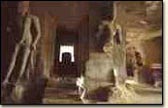 The Ajanta caves consist of 30 Caves
including the unfinished ones, dating back from 200 BC to 250 AD. These
caves are situated 104 Kms from Aurangabad and 52 Kms from Jalgaon Railway
station. The caves are cut from the volcanic lava of the Deccan in the
forest ravines of the Sahyadri Hills and are set in beautiful sylvan
surroundings. They were discovered accidentally by a British Captain, John
Smith in 1819, while on a hunting expedition.
The Ajanta caves consist of 30 Caves
including the unfinished ones, dating back from 200 BC to 250 AD. These
caves are situated 104 Kms from Aurangabad and 52 Kms from Jalgaon Railway
station. The caves are cut from the volcanic lava of the Deccan in the
forest ravines of the Sahyadri Hills and are set in beautiful sylvan
surroundings. They were discovered accidentally by a British Captain, John
Smith in 1819, while on a hunting expedition.
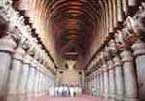 Ajanta provides a unique combination of
architecture, sculpture and paintings. Two basic types of monastic
Buddhist architecture are preserved at Ajanta, the Chaitya or prayer hall
(Cave Nos. 9,10,19,26, & 29) and Vihara or monastery ( remaining 25
caves). These caves suggest a well-defined form of architecture, broadly
resolving into two phases with a time gap of about 4 centuries from each
other. In the Hinayana Phase are included two Chaitya Halls (Caves Nos. 9
& 10) and 4 Viharas (Cave Nos. 8, 12, 13, and 15A). In the Mahayana
Phase are included 3 Chaityas (Cave Nos. 19 & 26 and 29 being
incomplete) and 11 exquisite Viharas ( Cave Nos. 1,2,4,6,7,11,15, and 20
to 24).
Ajanta provides a unique combination of
architecture, sculpture and paintings. Two basic types of monastic
Buddhist architecture are preserved at Ajanta, the Chaitya or prayer hall
(Cave Nos. 9,10,19,26, & 29) and Vihara or monastery ( remaining 25
caves). These caves suggest a well-defined form of architecture, broadly
resolving into two phases with a time gap of about 4 centuries from each
other. In the Hinayana Phase are included two Chaitya Halls (Caves Nos. 9
& 10) and 4 Viharas (Cave Nos. 8, 12, 13, and 15A). In the Mahayana
Phase are included 3 Chaityas (Cave Nos. 19 & 26 and 29 being
incomplete) and 11 exquisite Viharas ( Cave Nos. 1,2,4,6,7,11,15, and 20
to 24).
The Ajanta sculptures of the Mahayana Phase establish a formal religious imagery. While the Hinayana monuments at the site are virtually devoid of carvings, Cave 1, is one of the finest monasteries and the interior paintings here, are among the greatest at Ajanta. Graciously posed Bodhisattavas namely Padmapani and Vajrapani with elaborate headdresses flank the antechamber doorway. The walls on the side of the antechamber depict the assault and temptation by Mara and the miracle at Sravasti. Scenes from the Jataka tales such as Shibi Jataka, Samkhpala Jataka, Mahajanka Jataka, and Champeyya Jataka are depicted in the walls of the cave.
 Cave 2, monastery repeats the basic scheme of
Cave 1, and is also remarkable for its painted ceiling. The paintings
include, variety of designs, scrollwork, geometric patterns, miniature
seated Buddhas, dream of the Buddha’s mother, Maya and the birth of the
Buddha, procession of female devotees carrying offerings and scenes from
the Hamsa Jataka and Vidhurapandita Jataka. Caves 4 & 6 are Viharas or
monasteries or architectural interest.
Cave 2, monastery repeats the basic scheme of
Cave 1, and is also remarkable for its painted ceiling. The paintings
include, variety of designs, scrollwork, geometric patterns, miniature
seated Buddhas, dream of the Buddha’s mother, Maya and the birth of the
Buddha, procession of female devotees carrying offerings and scenes from
the Hamsa Jataka and Vidhurapandita Jataka. Caves 4 & 6 are Viharas or
monasteries or architectural interest.
Cave 9, 10, 12 & 15A, are Chaitya halls of
the Hinayana period. Cave 10 is among the first excavations at the site
and is one of the most impressive early Buddhist Chaitya Halls in Western
India dating back to the 2nd Century BC. This cave contains both the
earlier and later groups of paintings. Scenes from the Sama Jataka and
Chhaddanta Jataka are depicted. Cave 12 has lost its façade, with the
result that the interior square hall is now exposed. In cave 15A only
portions of the front wall survive.
Cave 14, 15 & 16 are Viharas belonging to the Mahayana Phase. Cave 14 was planned on a larger scale, but was never finished. The verandah of cave 15 has mostly fallen. Above the doorway is a stupa sheltered by a canopy of serpent hoods. Buddha images appear n the shrine and on the rear wall of the hall. Cave 16 is one of the finest monasteries at Ajanta. Within the hall on the left wall is an illustration of the conversion of Nanda, Buddha’s cousin. Other paintings include the miracle of Sravasti, elephant procession, Buddha begging for alms from his wife and son, Gautam’s first meditation, scenes from the Hasti Jataka and Maha Ummagga Jataka.
Cave 17, a Vihara preserves the greatest number of wall-paintings which includes a row of eight Buddhas, a much damaged panel of Indra flying through the clouds accompanied by his troupe of celestial dances, Apsaras and Musicians, Buddha subduing Nalagiri, the furious elephant sent by his jealous cousin Devadatta and scenes from various Jataka tales such as the Chhaddanta Jataka, Mahamapi Jataka, Vessantara Jataka, Sutasoma Jataka, Matiposaka Jataka, Sama Jataka, Ruru Jataka and Nigrodhamriga Jataka. Cave 19, is a perfectly executed rock-cut Chaitya. Cave 20 is a small monastery in which the antechamber protrudes into the hall and there are no columns. Cave 21 to 24 represent the last examples of work at Ajanta. They are all in different stages of completion. Cave 26 is a Chaitya Hall larger than that of Cave 19, but is otherwise similar in its arrangements and decorative scheme.
JUNNAR CAVES
BHAJA
CAVES
KANHERI
CAVES
Situated 42 Kms north of Mumbai, near Borivali, the Kanheri Caves were
once protected by a dense jungle. The caves are set in the heart of the
Borivali National Park. There are 109 Caves dating from 1st Century BC to
9th Century AD, each connected with a flight of steps. The most important
one is the Cave No. 3 of the 6th Century, which has the last of the
excavated Chaitya Hall of the Hinayana Order. It has 34 pillars and is
like a colonnaded hall 28 mtrs. x 13 mtrs. in dimension. These encircle a 5
mtrs. high Dagoba or Stupa and have carvings depicting elephants kneeling
and worshipping the Stupa. The other important caves are, Cave 11, the
Durbar Hall or the Assembly hall with a statue of the Buddha occupying the
central place as in the case of idols in Hindu temples and also a number
of cells for Buddhist monks. Cave 34 is a dark cell and has paintings of
the Buddha on the ceiling. Cave 41 has, besides other sculptures a figure
of the eleven headed Avalokiteshvara. Cave 67 is a high cell, with the
figure of Avalokiteshvara as saviour flanked by tow female figures in the
verandah. There are also images of the Buddha depicting the miracle of
Sravasti.
KARLA
CAVES
Dating back to the 2nd Century BC, the monuments at Karla are at a
distance of 11 km from Lonavala and just off the Mumbai-Pune road. The
magnificent Chaitya hall at Karla is the Largest ( 124 ft x 46.5 ft x 45
ft) and most evolved example of its class. Three important features of the
interior of the hall are columns or pillars, the roof vault and the great
sun windows. There are 37 columns in all, of which 30 have interesting
capitals showing prosperous men and women riding elephants and horses yet
bowing in humility to the Great Buddha. The vaulted roof has wooden
supports. This is the only place in India where 2000-year-old woodwork can
be seen. At the far end of the hall stands a stupa, above, which is held
an umbrella, a symbol of royalty. The whole system of lighting depends on
the enormous sun windows, through which cleverly diffused light with its
light and shadows gives a great sense of solemnity.